Showing posts with label world war one. Show all posts
Saturday, April 12, 2014
The A to Z Challenge: K is for Kiwi
(One thing we never use "kiwi" for is the fruit. To us it's always "kiwifruit", and it gives pause for thought whenever I hear someone talk of eating a kiwi!)
"Kiwi" originally referred only to the bird, an endearing (at least we think so!) stocky, flightless creature, with some unbirdlike characteristics all its own, like nostrils at the end of its long beak, cat-like whiskers at the beak's base, and soft feathers that are almost more like mammal hair than typical bird plumage. They're fully protected, but are relatively rare now—I saw my first one in the wild, as opposed to in a special kiwi house, just last year.
Kiwi became accepted as our national symbol around 1900, appearing on stamps and bank notes, trademarks and crests. Back then it stood for the country, but during the First World War something changed: it started to mean the people of New Zealand. These soldiers, many of them very young, were on the other side of the world, as far away as possible from their loved ones, and facing imminent danger. The kiwi is a creature found in its natural habitat only in New Zealand, and when a colloquial term was needed that referred to New Zealanders and could refer to no one else, they used the name of that familiar bird.
The name took root. We had become Kiwis. It's still how we typically refer to ourselves.
At the end of the war, thousands of Kiwi soldiers were packed into Sling Camp in southern England, waiting to return home. While they waited, they carved a reminder of home into the chalk of the hill overlooking the camp. It's still there today.
Friday, April 4, 2014
The A to Z Challenge: D is for Daisy
And also for Doctor.
Daisy is an only child; an oddity at a time when large families were the norm. She's a bright and imaginative girl, taking after her grandmother Amy in many ways, and cherished by her extended family.
Daisy's War looks at the experience of family members left to manage the farms during World War I, with so many of the men away. In the next book (still a work-in-progress), the family faces the challenge of the 1918 Influenza Pandemic, which in a two month period killed almost half as many New Zealanders as the four years of the war had done.
Daisy has dreams even larger than her grandmother's: she wants to be a doctor. In early 20th century New Zealand this is a large ambition, but Daisy is determined.
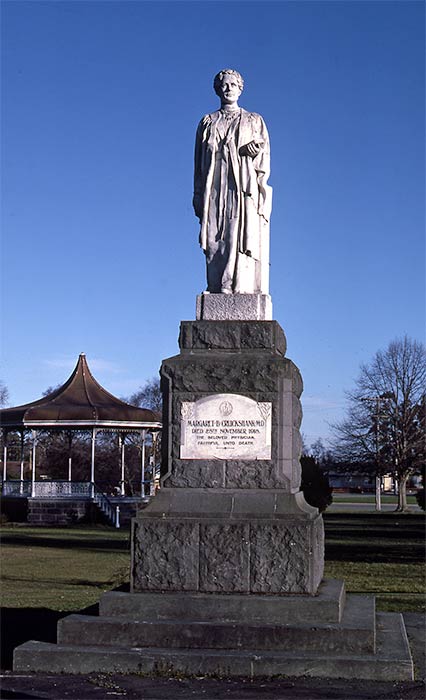
She's inspired by tales of woman doctors, including that of Margaret Cruickshank, who was New Zealand's first registered woman doctor.
Dr Cruickshank worked in the town of Waimate, in practice with a Dr Barclay. When the epidemic struck Waimate, Dr Barclay was still away on active service, and Margaret was managing the practice on her own. Her driver fell ill, but she continued to travel the district, by horse and gig or by bicycle, doing what she could for the sick. She even milked cows for some of her patients, in households where there was no one else to help.
By the time she caught influenza herself, her strength had been badly depleted. She died on 28 November 1918. The town of Waimate had a marble statue put up in her honour, inscribed with:
The Beloved Physician
Faithful unto Death
| Jock Phillips. 'Memorials and monuments - Civilian memorials, 1900–1945', Te Ara - the Encyclopedia of New Zealand |
Thursday, April 25, 2013
Anzac Day
Anzac Day
Among the food dishes named in honour of a battle is the Anzac biscuit. It originated in the biscuits sent to overseas troops during the Great War; biscuits that needed to be fairly tough and long-keeping, but which would have been hugely welcome both as a reminder of home and as a variation in diet. After Gallipoli, these crisp oaty biscuits were renamed Anzac biscuits.
The recipe for this biscuit comes in many variations, but this one makes a tasty, chewy snack. I made a batch this week in honour of the day:
They didn't last long, which is usually a good sign.
Wednesday, June 20, 2012
"Daisy's War" is here
It's sometimes disconcerting just how clearly characters can make their feelings known (as the mere author, I'm frequently not in charge), and Amy has made it very clear that she would much prefer a quieter life from now on, content to have a role in the lives of her grandchildren. While she is still an important presence in Daisy's War, the main focus has shifted from her, and I've had the pleasure of getting to know Daisy and Eddie much better.
Writing Daisy's War has held a new experience for me in how much this book's plot is shaped by a single historical event: the Great War of 1914-1918. In the earlier books events such as the Tarawera eruption, the baby-farming scandal and the struggle for women's suffrage affected my characters in varying degrees, but in this book their lives become increasingly intertwined with the War, as it grows from a shadowy threat to a very real one.
More than 100,000 New Zealanders served overseas in the Great War, and over 18,000 died; this in a country with a population of barely one million. The War must have had an effect on every household in New Zealand; it certainly touches everyone in my little valley.
Daisy's War is available now on Amazon.com and Amazon UK. It should appear at Barnes & Noble, iTunes and other retailers within the next few weeks.
Thursday, June 7, 2012
New Zealand horses in the Great War
Between 1914 and 1918, New Zealand sent more than 10,000 horses to Europe to serve in the Great War. Only four of those horses ever returned to New Zealand, and of that group only one served with New Zealand forces for the whole of the war, in the Middle East and later in Western Europe: Colonel Guy Powles’ horse Bess. Bess stayed with Colonel Powles for the rest of her life, eventually dying quite peacefully in 1934 while out for a ride with the Colonel.
Horses were also sent to South Africa with New Zealand troopers in the Anglo-Boer War (I send an imaginary trooper with his horse in Settling the Account), and at least one of those horses is known to have made it home.
More on the New Zealand warhorses, including photographs of Bess, here (warning: sad accounts of the fate of most of them).
Labels:
Bess,
Boer War,
horses,
Settling the Account,
world war one
Friday, April 27, 2012
Coming Soon: Daisy's War
In 1914, Daisy lives in the quiet New Zealand valley where her family has farmed for generations. A cherished only child with an adored older cousin, and surrounded by a sprawling extended family, her world seems a warm and safe one.
But the Great War is casting its long shadow over New Zealand. Daisy watches in growing fear as more and more of the men leave to fight in Europe, and the War strikes ever closer to the heart of her family.
Thursday, April 12, 2012
A Faithful Hound
Among the accounts of human suffering I've come across while researching my current work-in-progress, I stumbled upon something rather different: this tale of a faithful dog.
From the Bay of Plenty Times, February 1917:
The story of the faithful devotion of a sheep dog comes from Whakatane. Two years ago the master of the animal left Whakatane for the front, leaving it to be cared for by friends. Every day since, the faithful beast has gone to meet the Opotiki coach in a vain search for his absent master. The daily journey of the dog is a source of great interest to the residents of the town and to visitors.
Unfortunately the master's name is not given, so I've been unable to search the records to find out whether or not he survived to return home. I'd like to think that he did, and to a rapturous welcome.
From the Bay of Plenty Times, February 1917:
The story of the faithful devotion of a sheep dog comes from Whakatane. Two years ago the master of the animal left Whakatane for the front, leaving it to be cared for by friends. Every day since, the faithful beast has gone to meet the Opotiki coach in a vain search for his absent master. The daily journey of the dog is a source of great interest to the residents of the town and to visitors.
Unfortunately the master's name is not given, so I've been unable to search the records to find out whether or not he survived to return home. I'd like to think that he did, and to a rapturous welcome.
Wednesday, May 25, 2011
Passchendaele remembered
Recently I've been reading Glyn Harper's superb account of the New Zealand experience of Passchendaele. I've written here before about the Battle of Passchendaele and its horrific toll on New Zealanders.
This current reading came close to home—quite literally. At the back of the book is a list of names from the Memorial to the Missing at Tyne Cot Cemetery. To quote Harper: "The memorial bears the names of 1,179 New Zealanders who fell in the Passchendaele battles and whose bodies were never recovered."
I was going through this list, noting ages and what I could glean of personal circumstances, when the address of a next-of-kin sprang off the page. It's a short walk from our little apartment in town, in an area with many surviving Victorian houses, and a place I've walked past hundreds of times.
This house was built in the 1880s, and its exterior looks to have survived relatively unchanged. In October 1917 a telegram arrived for the widow who lived here. It told her that her son had been killed on the other side of the world. He was one of the 17,000 New Zealanders killed in the Great War.
I'll think of that young man, and of his grieving mother, every time I walk past her house.
This current reading came close to home—quite literally. At the back of the book is a list of names from the Memorial to the Missing at Tyne Cot Cemetery. To quote Harper: "The memorial bears the names of 1,179 New Zealanders who fell in the Passchendaele battles and whose bodies were never recovered."
I was going through this list, noting ages and what I could glean of personal circumstances, when the address of a next-of-kin sprang off the page. It's a short walk from our little apartment in town, in an area with many surviving Victorian houses, and a place I've walked past hundreds of times.
This house was built in the 1880s, and its exterior looks to have survived relatively unchanged. In October 1917 a telegram arrived for the widow who lived here. It told her that her son had been killed on the other side of the world. He was one of the 17,000 New Zealanders killed in the Great War.
I'll think of that young man, and of his grieving mother, every time I walk past her house.
Labels:
Glyn Harper,
Passchendaele,
world war one
Tuesday, October 12, 2010
Passchendaele
Today is the anniversary of what was, in terms of lives lost in a single day, the greatest disaster in New Zealand history. On the 12th of October 1917, during the Battle of Passchendale, 2,700 New Zealanders were killed or wounded. More on the battle can be found here.
Last year I went to an exhibition commemorating Passchendaele, sent to New Zealand by the Passchendaele Memorial Museum in Belgium. It was held at Fort Takapuna, from where some of the departing soldiers were deployed. On the grounds of the fort over 5,000 white crosses had been set up, one for every New Zealander killed in Flanders.

My work-in-progress has some of my characters being caught up in this battle. It's not really a spoiler to say that at least one will die there, because I could not claim to be at all realistic without reflecting something of the tragedy surrounding Passchendaele. Oddly enough, I have no sense that I'm "killing off" a character here; the death feels as inevitable as the events that drag these boys to Belgium. Foolish as it may sound, I do sometimes cry over characters who die; all the more so when it's one I've "known" since he was a child.
Last year I went to an exhibition commemorating Passchendaele, sent to New Zealand by the Passchendaele Memorial Museum in Belgium. It was held at Fort Takapuna, from where some of the departing soldiers were deployed. On the grounds of the fort over 5,000 white crosses had been set up, one for every New Zealander killed in Flanders.
My work-in-progress has some of my characters being caught up in this battle. It's not really a spoiler to say that at least one will die there, because I could not claim to be at all realistic without reflecting something of the tragedy surrounding Passchendaele. Oddly enough, I have no sense that I'm "killing off" a character here; the death feels as inevitable as the events that drag these boys to Belgium. Foolish as it may sound, I do sometimes cry over characters who die; all the more so when it's one I've "known" since he was a child.
Labels:
Passchendaele,
work-in-progress,
world war one
Saturday, April 24, 2010
Anzac Day
The 25th of April is a day when New Zealanders remember the landings at Gallipoli in 1915, and their tragic aftermath. To quote from an official New Zealand Anzac web site,
Anzac stands for Australian and New Zealand Army Corps. Anzac Day is formally recognised in Australia, New Zealand, and Tonga. There are also ceremonies to mark the day in many other countries, including Britain, Canada and the United States. And at Gallipoli itself, every year the day is marked by a dawn service attended by thousands.
I've been fortunate enough to visit Gallipoli, though not on Anzac Day. I'm glad to have had the chance to contemplate this place in silence.
Information on Anzac Day in New Zealand.
On this day the people of New Zealand have acknowledged the sacrifice of all those who have died in warfare, and the contribution and suffering of all those who have served.There are dawn services, often held at war memorials. When I was a child, many veterans of World War 1 marched in the parade (in fact I lived near a veteran of the Boer War, a man who lived to be 100). Now all our WW1 soldiers have passed on, and the survivors of WW2 are elderly. My father-in-law was one of the WW2 veterans; he died late last year, aged 89.
Anzac stands for Australian and New Zealand Army Corps. Anzac Day is formally recognised in Australia, New Zealand, and Tonga. There are also ceremonies to mark the day in many other countries, including Britain, Canada and the United States. And at Gallipoli itself, every year the day is marked by a dawn service attended by thousands.
I've been fortunate enough to visit Gallipoli, though not on Anzac Day. I'm glad to have had the chance to contemplate this place in silence.
Information on Anzac Day in New Zealand.
Wednesday, November 11, 2009
This week in New Zealand history: Armistice Day
On the 12th of November 1918 (it was still the 11th in Europe), the official announcement of Armistice was published in New Zealand. After four years of hostilities, the Great War was over. In towns up and down the country, parades with brass bands and decorated floats, returned soldiers and schoolchildren, marched carrying banners and flags.
18,000 New Zealanders had died in the war, out of a population a little over one million; the highest death rate of any country in the British Empire, and one of the highest of any participating nation. Many of those people lining the streets to watch the parades would have been in mourning.
There were no parades in Auckland. The city's Chief Health Officer did not allow any official celebrations for Armistice Day - because crowds were something to fear. The war might be over, but deaths were not. Influenza was ravaging the country.
18,000 New Zealanders had died in the war, out of a population a little over one million; the highest death rate of any country in the British Empire, and one of the highest of any participating nation. Many of those people lining the streets to watch the parades would have been in mourning.
There were no parades in Auckland. The city's Chief Health Officer did not allow any official celebrations for Armistice Day - because crowds were something to fear. The war might be over, but deaths were not. Influenza was ravaging the country.
Labels:
1918,
armistice day,
influenza pandemic,
world war one
Saturday, November 7, 2009
An Avenue of Lime Trees
Last month we spent some time in the pretty little Wairarapa settlement of Greytown. From the time it was bypassed by the railway line, "development" left Greytown behind. As a result, it's well-endowed with Victorian buildings, both commercial and residential, and is now a popular spot for weekend visitors.
But what I specially wanted to see was the lime tree avenue in the Soldiers' Memorial Park.
Every town in New Zealand, small or large, has a war memorial of some sort, put up after World War I. Most often it's a tall monument known as a cenotaph. In Greytown the townsfolk did something different: they planted an avenue of lime trees. One tree for every soldier from the district who died in the war. One hundred and seventeen trees.
A town that before the war had a population of 1,123 lost 117 men in that war. There cannot have been a family left unscathed. Not a household that didn't lose a husband, a brother, a son. Girls who lost their sweethearts; women who never did meet the men who might have become their husbands. Farms "let go" because the strong young men who would have worked it never came home. As we walked along that long avenue, speaking in the hush that such a place evokes, it was a more powerful illustration of loss than any page of figures could be.
But what I specially wanted to see was the lime tree avenue in the Soldiers' Memorial Park.
Every town in New Zealand, small or large, has a war memorial of some sort, put up after World War I. Most often it's a tall monument known as a cenotaph. In Greytown the townsfolk did something different: they planted an avenue of lime trees. One tree for every soldier from the district who died in the war. One hundred and seventeen trees.
A town that before the war had a population of 1,123 lost 117 men in that war. There cannot have been a family left unscathed. Not a household that didn't lose a husband, a brother, a son. Girls who lost their sweethearts; women who never did meet the men who might have become their husbands. Farms "let go" because the strong young men who would have worked it never came home. As we walked along that long avenue, speaking in the hush that such a place evokes, it was a more powerful illustration of loss than any page of figures could be.
Labels:
Greytown,
history,
New Zealand,
Wairarapa,
war memorials,
world war one
Subscribe to:
Posts (Atom)